Skip to content

Introduction: Why are we actually returning to traditional houses?
If you’ve noticed an explosion in traditional accommodation offers and an incredible increase in demand in recent years… you’re not alone. Tourists from across the country — and abroad — are increasingly shunning perfect, polished, and standardized hotels, retreating to places that seem to belong to another era.
But the real question is:
Why do tourists choose traditional houses?
What exactly are we looking for there?
And why are these places becoming “the new luxury“?
It’s not just nostalgia for the village or childhood spent at grandparents’. It’s something much deeper.
In this comprehensive article, we will explore in detail the psychological, cultural, emotional, and practical reasons behind this global — not just Romanian — trend. We will compare traditional houses with modern accommodations, use real examples, research, perspectives from hospitality experts, and even discuss counterarguments.
We will also analyze a concrete example: Oberwood, a complex of restored traditional houses, which perfectly illustrates everything tourists desire in 2026.
This is a complete guide — a clear, empathetic, comparative, and deeply relevant explanation for any accommodation owner, tourist, tourism entrepreneur, or traditional heritage enthusiast.
Contents
Why Tourists Choose Traditional Houses: 10 Real, Proven, and Ever-Relevant Reasons
Before discussing amenities, landscapes, or comfort, tourists seek something much deeper: the feeling of experiencing something real. And among all the reasons that draw them to traditional houses, authenticity is the first — and the one that gives meaning to all the others.
Authenticity remains where things do not try to impress, but simply to be.
Authenticity: The Strongest Need of Modern Tourists
In a world where “everything can be copied,” authenticity has become a rare commodity.
Modern hotels look impeccable, but they look the same. They are comfortable, but sterile. They are correct, but predictable.
Traditional houses, on the other hand, are impossible to standardize.
There you will find:
- old architecture respectfully restored, not reinvented
- authentic objects, not decorative replicas from a design store
- traces of time passing, not perfectly smooth surfaces
- a real story, not a marketing concept
For tourists, authenticity is not a whim. It is a response to a deep emotional need:
to feel that they are experiencing something real.
Tourists prefer an experience with local identity over an industrialized one.
Where the Difference is Felt
| Accommodation Type | What the Tourist Feels |
| Modern Hotel | “It’s nice… but it could be anywhere in the world.” |
| Traditional House | “I feel like I belong here. There’s a story here.” |
Real Anecdote
A German tourist recounted that, after visiting 7 cities in two weeks, it was only at a traditional house in Maramureș that she “truly felt she had traveled.”
Hotels seemed “soulless” to her. But the wooden house, with a veranda and the smell of smoke, felt like home.
This is the impact of authenticity.
Deep Connection with Nature: An Emotional and Physiological Reason
People seek nature not just for photos, but because their bodies demand it.
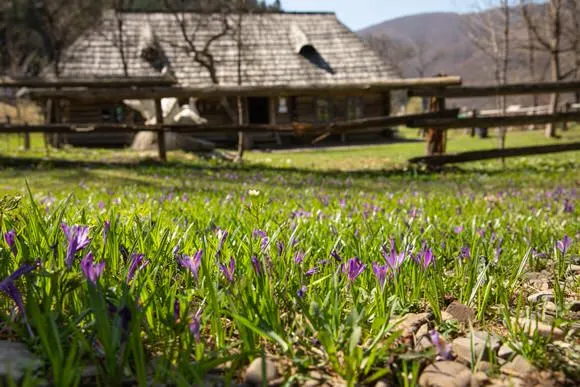
Traditional houses are typically located in:
- quiet villages
- mountain areas
- wooded areas
- places without constant traffic
This context has real effects on health:
- stress reduction
- deeper sleep
- decreased anxiety levels
- increased serotonin
- mental reset
Tourists feel a strong need for mental reset and tranquility.
Sensations That Make Tourists Return
- the sound of wind through the trees
- the smell of wet wood after rain
- birds chirping in the morning
- absence of noise pollution

Natural Materials: Organic Comfort You Cannot Buy
The most appreciated traditional houses are built from:
- solid wood
- stone
- clay
- lime
These materials create an indoor microclimate that even the most advanced technology cannot reproduce.
They:
- naturally regulate temperature
- stabilize humidity
- create a warm atmosphere
- offer a sense of “home”
Why This Matters to Tourists
Because most of us live in concrete apartments, with air conditioning and artificial ventilation.
In traditional houses, the body immediately feels the difference, even if the tourist cannot technically explain it.
It’s instinctive comfort.
A kind of “calm of natural materials” that you feel without knowing why.
The Desire for Simplicity and Minimalism: A Counterbalance to Modern Hustle
In recent years, tourists are no longer looking for “more,” but less — but better. Less noise, fewer visual stimuli, less pressure. In a society dominated by screens, notifications, multitasking, and information overload, simplicity has become a real psychological need, not an aesthetic trend.
Traditional houses perfectly meet this need through a type of minimalism different from urban minimalism. We are not talking about cold, white, and impersonal spaces, but about a warm minimalism, built on functional logic and natural balance:
- airy rooms, with few objects, but meaningful ones
- robust furniture, with a clear, not decorative, role
- spaces that “breathe,” not clutter
- absence of unnecessary, distracting technology
In a traditional house, nothing is in excess. Every element exists because it was necessary, not because it “looks good in photos.” And this natural order is directly transmitted to the tourist’s state of mind.
Many guests describe this experience as a mental detox: the mind calms down because the environment no longer constantly demands its attention. There is no longer the pressure to “consume experiences,” to check off amenities, or to follow a forced schedule. Everything slows down naturally.
This explains why phrases such as “tranquility,” “escape,” “slow living,” “stress-free vacation” are increasingly sought after in association with traditional house accommodation. Simplicity is no longer perceived as a lack, but as emotional luxury.
We live in a world where notifications never stop.
Phones, deadlines, traffic, screens — all of them overload us.
In summary:
Tourists choose traditional houses because there they find:
- airy spaces
- simple, yet warm decor
- absence of unnecessary technology
- a natural order
- visual tranquility
While modern hotels compete in amenities, traditional houses offer the essential.
And that is exactly what tourists tired of urban chaos need.

Authentic Experiences Have Become the New Luxury
If in the past luxury meant opulence, today it is defined by rarity, depth, and meaning. Modern tourists are no longer impressed by marble, chandeliers, or endless menus. They are impressed by what cannot be easily replicated.
And authentic experiences, lived in a traditional house, are precisely this type of luxury.
What does “the new luxury” mean, specifically, for tourists?
- drinking coffee quietly on a wooden porch, without traffic noise
- waking up with natural light, not a phone alarm
- staying in a space with a real history, not an invented design concept
- feeling that time is not rushing you
This type of experience is emotional, not demonstrative. It’s not about showing others where you’ve been, but about how you felt there. That’s why tourists who choose traditional houses are much more likely to return and recommend the place, because the connection created is personal.
From the perspective of perceived value, a night spent in a well-restored traditional house is considered more “precious” than one in a standardized hotel, even if the price is similar. The reason is simple: the experience cannot be duplicated.
This is why, in modern tourism and hospitality strategies, the focus is shifting from “amenities” to memorable experiences — exactly what traditional houses naturally offer.
Luxury no longer means gold, marble, crystal.
Luxury, in 2026, means:
- total tranquility
- quality time
- nature
- authenticity
- intimacy
- natural materials
- local stories
Comparison – Luxury "of yesterday" vs. Luxury "of today"
Type of Luxury | Examples | How it feels |
Traditional Luxury | 5-star hotel, spa, room service | Impressive, but cold |
Modern Luxury | impeccably restored traditional house | Rare, warm, memorable |
Tourists no longer want to be artificially “pampered.”
They want to feel connected.
Connection with Local Traditions and Village Life
Another major reason why tourists choose traditional houses is the desire for a real connection with the place. Not with an abstract destination, but with life as it is lived by the local community.
Unlike hotels, which often create an isolated “bubble,” traditional houses are an integral part of the village. They offer access to:
- the authentic rhythm of rural life
- local gastronomy, based on recipes passed down through generations
- traditional crafts and real stories
- natural human interactions, not standardized client-staff relationships
For foreign tourists, this connection is often the main reason for their trip. They don’t just come to see Romania, but to understand it. And this cannot happen in a culturally neutral space.
For Romanian tourists, the experience has a different, but equally powerful dimension: reconnecting with roots, with a simpler life, with forgotten values. Many describe these vacations as a symbolic “return home”, even if they are not from that specific area.
This chapter strongly supports searches such as “authentic experiences,” “rural tourism,” “village life,” “local traditions”, all of which are direct associations with traditional houses as a form of premium accommodation.
This is one of the strongest motivations — especially for foreign tourists.
Traditional houses offer:
- real contacts with the community
- authentic gastronomy
- old crafts (weaving, carving, pottery)
- proximity to animals and rural activities
- local stories
Why does this matter?
Because tourists are not just looking for relaxation.
They are looking for meaning.
They are looking for something that will stay in their hearts, not just in their photo gallery.
Intimacy: The Decisive Factor for Couples and Families
As mass tourism becomes increasingly tiresome, intimacy has become a decisive criterion in choosing accommodation. And here, traditional houses have an undeniable advantage.
Unlike hotels, where space is shared with dozens or hundreds of other guests, a traditional house offers:
- private or semi-private courtyard
- completely independent spaces
- absence of constant noise
- total freedom of movement
- the clear feeling of “your own space”
For couples, this intimacy means authentic romance, without interruptions or the feeling of crowding. For families, it means safety, freedom for children, and real relaxation for adults.
Moreover, intimacy is not just physical, but also emotional. Tourists feel more relaxed, more present, more connected to each other when they are not constantly exposed to other people.
This aspect explains why traditional houses are preferred for romantic getaways, family vacations, retreats, or workations. They create the ideal setting for reconnection — with loved ones and with oneself.
In a hotel, you hear everything happening around you — and everyone hears you.
In a traditional house, it’s just you and your people.

Who This Type of Accommodation is Perfect For
- couples seeking romance
- families with children who want freedom
- small groups
- personal retreats
- people working remotely who desire complete tranquility
Intimacy is not a bonus. It is a real reason to choose these places.
Unique Atmosphere: "Time Flows Differently Here"
Perhaps the most difficult to define, but most frequently mentioned reason why tourists choose traditional houses is the atmosphere. A state. A feeling. A perception that appears almost immediately upon arrival.
Guests frequently say things like:
- “time seems to stand still here”
- “I feel a tranquility that doesn’t exist elsewhere”
- “nothing is rushing me”
This atmosphere is the result of a rare combination, impossible to artificially reproduce:
- natural materials that age beautifully
- warm, filtered light
- objects with real history
- human, not industrial, proportions
- absence of commercial pressure

In a traditional house, you are not treated as a “client in transit,” but as a guest in a space with a soul. And this completely changes how you experience your vacation.
From the perspective of the tourist experience, this atmosphere is what transforms a simple accommodation into a powerful memory, one that lingers long after the vacation has ended.
Personalized, Not Standardized, Experiences
In a traditional house, the experience is not built according to a template, but according to the history of each individual space. There are no identical rooms, because these houses were not designed to be multiplied, but to be lived in. Each room bears the traces of time, of the hands that built it, and of the lives that passed through it.
A room might have an old, slightly slanted beam that tells the story of the craftsman who cut the wood decades or centuries ago. Another might have a small window, facing east, through which light enters differently each morning. In one corner, a dowry chest saved from an abandoned household becomes a bedside table. In another, a restored stove is not just a decorative element, but the emotional center of the space.
This diversity creates a profound sense of authentic uniqueness. Tourists do not feel like they are occupying “room 12,” but that they are temporarily living in a space with its own identity. And this difference, though subtle, completely changes how the vacation is experienced.
In hotels, rooms are designed for efficiency and replication. Everything is calculated to look the same, function the same, and offer the same experience, regardless of who enters the door. In a traditional house, however, the experience is personal, intimate, and unrepeatable. It cannot be reproduced even in the same house, from one room to another.
This lack of standardization is, paradoxically, one of the most appreciated “services” by modern tourists. People no longer seek absolute predictability, but pleasant surprise, character, and emotion. The fact that each room has its own story makes guests feel chosen, not assigned.
Moreover, the personalized experience does not stop at the visual level. It extends to how the space is lived: the rhythm of the day, the way light changes on the walls, the specific tranquility of each room, the different relationship with the exterior. All of these create the feeling that the stay is not “consumed,” but truly lived.
That’s why tourists remember exactly which room they stayed in, which object caught their attention, and which window became their favorite. Not because it was “the most luxurious,” but because it was theirs. And this form of emotional personalization is impossible to replicate in a standardized system.
Ultimately, the experiences offered by traditional houses are not just different — they are deeply personal. They do not repeat, they do not copy, and they are not easily forgotten. That is why, for an increasing number of tourists, these no longer represent an alternative to hotels, but the only form of accommodation that truly offers meaning, identity, and memory.
Examples of Unique Elements That Fascinate Tourists
- a hand-carved bed
- an old beam with axe marks
- a restored traditional stove
- a 100-year-old dowry chest
- a porch with original beams
These elements don’t just “look nice.”
They tell a story — and the tourist feels part of it.
Oberwood: The Perfect Example of Why Tourists Choose Traditional Houses
Oberwood is not just a complex of restored traditional houses. It is a clear synthesis of all the reasons why tourists today choose this type of accommodation over standardized hotels. Every element — from architecture and materials to location and atmosphere — naturally follows the direction towards a return to the essential, to the authentic, to meaningful experiences.
Guests do not come to Oberwood for “a night’s stay,” but for a state of being. For that rare feeling that they have truly stepped out of the daily rhythm and entered a space that does not rush them, does not demand their attention, and does not force them to consume experiences.
Real Authenticity, Not Commercial Reinterpretation
Oberwood serves as an ideal example of authenticity precisely because it does not try to appear traditional, but is. The houses are not new constructions “artificially aged,” but structures with history, saved and brought back to life through a careful restoration process.
Tourists choose Oberwood because it offers real authenticity: traditional houses respectfully restored, natural materials, and spaces with identity, not thematic decor.
Here, authenticity is not a marketing concept, but a lived experience:
- old beams bearing the marks of time
- natural textures that cannot be industrially replicated
- architectural proportions designed for life, not for 3D rendering
Modern tourists seek real local identity, not neutral spaces that could exist anywhere in the world.
Deep Connection with Nature and a Slow Pace
All Oberwood locations share the same essential characteristic: they do not compete with nature, but allow it to guide the experience. Here, nature is not a backdrop for photos, but an integral part of guests’ daily lives.
Mornings begin with natural light and tranquility, not traffic or notifications. Days flow without pressure, and evenings bring the kind of calm that tourists often describe as “healing.”
Oberwood is chosen for its tranquility, nature, and mental reset, being situated in a context that promotes deep sleep, stress reduction, and reconnection with oneself.
Simplicity and Warm Minimalism: The Opposite of Modern Hustle
Oberwood does not impress with abundance, but with balance. The spaces are visually clean, orderly, and airy, without being cold or impersonal. Every object has a purpose, every detail is chosen for comfort and atmosphere, not for excessive decor.
This well-thought-out simplicity acts as a natural antidote to hectic urban life.
Oberwood offers a warm minimalism, based on functional simplicity, natural materials, and airy spaces that reduce mental overload.

Authentic Experiences as the New Luxury
Oberwood positions itself perfectly within the paradigm of the new luxury: it does not promise more, but more authentic. Luxury is defined by:
- time that does not pressure you
- space that belongs to you
- real tranquility
- the feeling of “home,” not a tourist unit
Tourists are no longer looking to be impressed, but to be emotionally touched.
At Oberwood, luxury does not mean opulence, but tranquility, space, intimacy, and authentic experiences, difficult to replicate in hotels.
Connection with Local Traditions and Village Life
Without forced animation, without “themed packages,” Oberwood allows guests to connect with the real rhythm of the place. Tradition is not put on display, but lived discreetly, through architecture, objects, stories, and context.
For foreign tourists, it is an authentic discovery. For Romanian tourists, it is a profound reconnection with values and roots.
Oberwood offers natural access to village life and local traditions, without artificiality or “tourist spectacle.”
Intimacy: The Decisive Argument for Couples and Families
Oberwood houses offer precisely the type of intimacy that hotels cannot guarantee:
- no shared walls with neighbors
- absence of constant noise
- private courtyards and spaces
- total freedom for children and couples
This intimacy is one of the decisive conversion factors.
Oberwood is chosen by couples and families for real intimacy: independent spaces, complete tranquility, and full freedom.
Unique Atmosphere: "Time Flows Differently Here"
Tourists describe Oberwood as a place where time slows down, thanks to the combination of traditional architecture, natural materials, and profound tranquility.
The Oberwood atmosphere is not created, but naturally results from everything the place embodies: proportions, light, textures, sounds, the absence of hustle and bustle. This is where the feeling — constantly reiterated by guests — that time no longer exerts the same pressure, arises.
Why Oberwood is Not Just an Example, But a Confirmation
All these elements — authenticity, nature, simplicity, real experiences, traditions, intimacy, and atmosphere — make Oberwood a practical confirmation of why tourists choose traditional houses in 2026.
It is not an exception. It is clear proof that this direction works.
For those seeking a meaningful vacation, not just a place to sleep, Oberwood is not an alternative to hotels — it is a conscious choice.
A choice for tranquility, authenticity, and unique experiences.
Counterarguments and Legitimate Questions: Are Traditional Houses Really for Everyone?
Frequent Question / Objection | Why This Concern Arises | Realistic and Balanced Answer | Important Clarification for the Tourist |
“Traditional houses do not offer modern comfort.” | Many associate old houses with lack of insulation, unsuitable bathrooms, or uncomfortable furniture. | Traditional houses correctly restored offer complete modern comfort, discreetly integrated: modern bathrooms, efficient heating, comfortable beds. | The difference is not between “old” and “modern,” but between professional restoration and improvisation. |
“I’m afraid it will be cold or damp.” | There are negative experiences with neglected or abandoned old houses. | Natural materials (wood, stone, clay) naturally regulate temperature and humidity, if properly implemented. | A well-restored traditional house is often more climatically stable than a standard modern construction. |
“I don’t like being isolated.” | Some tourists prefer urban energy, events, and intense social life. | Traditional houses are designed for tranquility and retreat, not for hustle and bustle. | It is not a limitation, but a choice of vacation style. |
“I don’t need authenticity, I want predictability.” | Some tourists appreciate standardization and the absence of surprises. | Traditional houses offer unique, non-replicable experiences; this can be a drawback for those who want everything identical. | This type of accommodation is ideal for those seeking emotion and character, not uniformity. |
“There are not enough amenities.” | Expectations formed by hotels: room service, spa, in-house restaurants. | Traditional houses emphasize the essential and quality, not a volume of amenities. | A vacation is not about “how many things you do,” but about how you feel. |
“The internet is weak or non-existent.” | Frequent prejudice related to rural areas. | Most modern traditional house accommodations offer stable Wi-Fi, discreetly integrated. | The difference is that the internet does not dominate the experience, but remains optional. |
“They are not suitable for children.” | Fear of lack of safety or limited spaces. | In fact, many traditional houses are more family-friendly: courtyards, space, freedom of movement. | Children often feel freer and more connected in this type of environment. |
“They are not for everyone.” | Perception that this type of accommodation is “niche.” | It’s true: traditional houses are not for everyone. | It is precisely this natural selection that makes them so appreciated by the right people. |
Traditional houses do not try to please everyone — and that is precisely where their strength lies. They cater to those who seek tranquility instead of noise, meaning instead of excess, and experience instead of standardization. For this type of tourist, traditional houses are not an alternative, but the ideal choice.
Why do tourists choose traditional houses? Because we are returning to what is real.
If we were to summarize everything in one idea, it would be this:
Tourists choose traditional houses because they want to feel something. Not just to see something.
They choose:
- authenticity
- tranquility
- natural materials
- local traditions
- intimacy
- unique atmosphere
- rare experiences
- real stories
- reconnection with nature
In an increasingly fast-paced, artificial, and digitized world, traditional houses offer the exact opposite: a return to the essential.
And that, in 2026, represents true luxury.