Skip to content

From vernacular architecture to premium experiences that restore the meaning of authenticity
Introduction — Why traditional houses fascinate us today
There comes a moment when, as you travel through the villages of Transylvania, you feel time slow down. The old houses, the stillness between the hills, the wood smoothed by rain and sun—everything makes you wonder what life looked like for those who lived here hundreds of years ago.
And perhaps it may surprise you that this appeal is not merely nostalgia.
People are increasingly looking for experiences that reconnect them with natural rhythms, simple traditions, and spaces that tell a real, not invented, story.
In the last 20 years, traditional houses in Transylvania have experienced a renaissance that few could have anticipated. Something that seemed destined for abandonment has been transformed into premium destinations, into models of sustainability, into restoration projects that honor the past and embrace the future.
How did this happen?
In this comprehensive article, we explore — step by step — the evolution of traditional houses in Transylvania, combining history, architecture, anthropology, tourism trends, and concrete examples from the field.
Contents
The origins of traditional houses in Transylvania: architecture born from environment, resources, and mentality
If you want to understand traditional Transylvanian houses, you must start with a simple truth: they are not the result of an imposed style or an architectural fashion, but the direct consequence of adapting to the environment.
Every construction decision—from the thickness of the walls to the orientation of the house—was made out of necessity, not aesthetics, and this necessity was dictated by nature and historical context.
The Carpathian Mountains, with their rugged terrain and harsh climate, demanded robust building solutions. Long, cold winters called for compact homes with thick walls, small windows, and tall roofs, designed to retain heat and withstand heavy snowfall.
At the same time, short summers—though sometimes scorching—were balanced by the use of solid timber and natural materials that regulate temperature naturally.
Local resources played an essential role. Wood from oak, beech, or fir forests and stone extracted from the immediate vicinity were not only the most accessible materials, but also the most suitable for a rural, self-sufficient way of life.
Construction thus became a community act, based on what the place offered, not on what could be brought from outside.

Added to this natural context is a historical one: Transylvania was, for centuries, a border region, with limited access to major urban centres and a predominantly rural population. Distance from the cities meant autonomy, but also the preservation of building techniques passed down from generation to generation.
The houses evolved slowly, organically, without abrupt breaks, maintaining a coherence that is today perceived as authenticity.
Thus, Transylvanian vernacular architecture cannot be separated from the landscape in which it emerged. It is the expression of a relationship of balance between people and nature, between necessity and ingenuity, between survival and harmony.
It is precisely this deep adaptation to the environment that explains why, hundreds of years later, these houses continue to be not only functional, but also surprisingly comfortable and relevant to the contemporary lifestyle.
Natural materials as a survival solution
The harmony between man and nature has materialized in clear construction choices, based on local resources and traditional techniques that have ensured the durability and comfort of homes over generations:
- oak, beech, or fir wood for walls and structures
- local stone, often unprocessed, for the foundation
- shingles or burnt tiles for roofs
- lime and earth for finishes and protection
These materials were not only traditional—they were the only ones available, and each village had its own techniques passed down from generation to generation.
Functional architecture: simplicity with purpose
Traditional houses did not try to impress. They fulfilled their function.
The defining elements include:
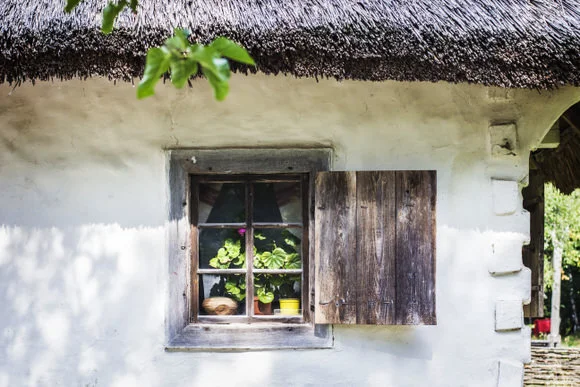
- Small windows, to conserve heat.
- Steep roofs, excellent for preventing snow accumulation.
- Porches and verandas, transitional spaces between inside and outside.
- Massive beams, joined without nails, using advanced carpentry techniques.
It is fascinating that these solutions, created out of necessity, are today appreciated as models of natural energy efficiency.
From utilitarian to cultural expression: when the house becomes an identity symbol
Traditional architecture did not appear as an artistic expression, but as a direct response to life. The first houses did not “follow a style”, but solved concrete problems: cold, humidity, safety, storage, family life. That is why the stylistic evolution came naturally, over time, as communities stabilized, and the house became more than just a shelter.
In Transylvania, this evolution can be clearly seen in seemingly minor details:
- the shape and proportion of the porch
- the way a beam is carved
- the colors of the facade
- the type of gate
- the relationship between the house, the yard, and the village
As the household also became a form of representation, the house began to tell a story about:
- social status
- ethnic affiliation (Romanians, Saxons, Szeklers)
- occupation and prosperity
- respect for tradition
This is how local styles appear: the Saxon house with an orderly facade and geometric rhythm, the Romanian house with an open porch and vegetal decorations, the Szekler household marked by the monumental gate.
One thing is essential:
the style was not imposed, but built from within the community.
This authenticity explains why traditional architecture is still perceived today as “beautiful”, even though it was not created for aesthetics, but for living.
The houses began to include:
- carved porches, with solar or vegetal motifs
- facades in pastel colors: Saxon blue, pale green, whitish
- monumental gates in the Szekler areas
- painted furniture, with floral motifs
In many villages, the way the house looked conveyed:
- the social status of the family
- ethnic affiliation (Romanians, Hungarians, Saxons)
- the main occupation
- local traditions
Architecture thus becomes a visual language. Each detail says something about the values and aspirations of the community

The 20th Century: Between Degradation, Industrialization, and Loss of Identity
The 20th century brought the greatest rupture in the history of the Romanian village. Industrialization, collectivization, urbanization, and the radical change in lifestyle produced a brutal modernization, hurried, lacking respect for heritage.
Traditional houses began to be perceived as:
- “old”
- “uncomfortable”
- “shameful”
- “impractical”
In the absence of education towards heritage, modernization meant:
- replacing windows with PVC
- shiny metal roofs
- polystyrene thermal insulation applied over old wood
- complete demolitions and concrete reconstructions
The result?
a massive loss of rural identity.
Paradoxically, this period of degradation also created the conditions for today’s rebirth. The moment something becomes rare, it begins to be valuable. And traditional houses have suddenly become unrepeatable.
Traditional houses, difficult to maintain and considered “uncomfortable”, were:
- completely abandoned
- replaced with concrete constructions
- aggressively modified (PVC windows, cheap metal roofs, polystyrene-insulated walls)
In the 80s and 90s, numerous traditional households disappeared, and others were visually mutilated.
However, paradoxically, this period of near-disappearance paved the way for the authentic rebirth that was to come.
The Rebirth of Interest: The Search for Authenticity in the 21st Century
In a digital, accelerated, artificial world, people are no longer just looking for comfort. They are looking for meaning.
And traditional houses offer exactly that.
Their rediscovery is not a passing fad, but a global phenomenon, supported by several major trends:
- slow living
- experiential tourism
- reconnecting with nature
- the need for real, not simulated, silence
A properly restored traditional house offers:
- authentic silence, not artificial soundproofing
- living materials: wood, stone, lime
- imperfections that tell stories
- a rhythm of the day dictated by light, not notifications
For many tourists, the experience in such a house becomes:
“the first time I really breathe.”
That’s why traditional houses are no longer just places to stay, but spaces for personal reconnection, used for:
- retreats
- conscious vacations
- emotional breaks
- quality time with family
In the last decade, a strong trend has emerged in tourism:
Travelers are no longer just looking for places to sleep, but places to feel.
And the traditional houses of Transylvania offer exactly that:
- silence
- connection with nature
- authentic cultural heritage
- real stories
- simple but memorable experiences
Global tourism is increasingly moving towards the concept of slow living, and Transylvania has become a European symbol of this lifestyle.
Crafts are coming back into focus
With the interest in restoration, crafts have also been reborn:
- traditional carpentry
- furniture painting
- working with shingles
- restoring Szekler gates
- reconditioning old objects
Thus, heritage is no longer just preserved, but put back into use.
Proper restoration: the bridge between past and present
Many believe that restoration means “making the house look like new.”
In fact, authentic restoration is pursued on several levels.
The difference between conservation and decoration
Authentic restoration is perhaps the most misunderstood concept in this field.
Many confuse it with “beautiful renovation.” In reality, it is exactly the opposite.
Authentic restoration means:
- preserving the original structure
- respecting the initial proportions
- reusing old materials whenever possible
- minimal but intelligent interventions
- integrating modern comfort without dominating the space

Authentic restoration does NOT mean:
- “rustic style” applied over concrete
- new furniture “artificially aged”
- destroying the porch for interior space
- standard double-glazed windows in a historic facade
- kitsch packaged as tradition

A proper restoration requires:
- specialized craftsmen
- time
- patience
- budget
- a clear philosophy
But the result is incomparable:
a house that lives, doesn’t just look good.
This entire balance transforms a traditional house into a space relevant to the contemporary lifestyle.
From simple dwellings to premium experiences: transforming traditional houses into top destinations
For a long time, the idea of a premium experience has been associated with large surfaces, glossy materials, visible technology, and standardized comfort. Identical hotels in different cities, rooms that look the same anywhere in the world, impeccable but impersonal spaces.
Today, however, this definition is beginning to change radically.
In the context of contemporary tourism, “premium” is no longer about excess, but about meaning. It’s no longer about how much, but about how well. It’s no longer about display, but about living.
A premium experience in a traditional house does not compete with classic luxury — it redefines it. It offers something much rarer: real authenticity, profound comfort, and a state of tranquility difficult to replicate in modern constructions.
This is where the real “evolution” comes in: the transition from house → accommodation → cultural experience.

A premium traditional house includes:
- refurbished furniture or furniture made by local craftsmen
- natural textiles: linen, hemp, organic cotton
- spacious bathrooms with natural finishes
- gardens with local plants, not artificial arrangements
- views of mountains, forests, or orchards
- spaces that encourage tranquility and reflection
Why do tourists choose such places?
Because they offer what hotels cannot offer:
- peace of mind — not just silence, but a different inner rhythm
- local rituals: milking the cow, the passing of the herd, bread baked in the oven in the yard
- authentic gastronomy, cooked as “at mother’s home”
- community, stories, emotions
- simple but spectacular hikes
These experiences cannot be bought on the internet — they must be lived.
That’s why they have become a luxury of simplicity.
The science behind traditional comfort
There is a question that many guests ask themselves after the first night spent in a restored traditional house:
“Why do I feel so good here, even though I can’t point to a clear reason?”
The answer is not about nostalgia, nor about rural romanticism. It’s about intuitively applied science, long before terms such as “energy efficiency”, “passive architecture” or “indoor comfort” existed.
Traditional houses were not designed by architects in offices, but by communities that tested, generation after generation, what really works. The result is a type of deep, stable, and natural comfort — a comfort that does not depend on technology, but on the balance between material, form, orientation, and rhythm.
Thick walls – natural temperature regulators
One of the most important elements of traditional comfort is thermal mass.
Thick walls made of solid wood, stone, earth, or combinations thereof act as a true climatic buffer.
These:
- absorb heat during the day
- release it slowly at night
- maintain coolness on hot days
- stabilize the interior temperature in the long term
Unlike modern constructions, which react quickly to external changes, traditional houses cushion the extremes. That’s why the feeling of comfort is constant, not fluctuating.
Solid wood – a living, breathing material
The wood used in traditional houses is not just a structural element. It is an active material, with physical and biological properties that directly influence well-being.
Solid wood:
- regulates indoor humidity
- reduces the feeling of “dry” or “heavy” air
- absorbs and releases vapors naturally
- contributes to a healthy microclimate
Furthermore, modern studies show that the presence of natural wood in living spaces reduces stress and improves sleep quality — an effect that villagers have known intuitively for centuries.
High roofs and the geometry of air
The shape of the roof is not an aesthetic detail, but a precise climatic calculation.
High roofs with steep slopes allow for:
- the accumulation of hot air at the top
- natural air circulation
- reducing overheating of living spaces
In combination with airy attics, this system works as passive ventilation, without fans or mechanical systems.
Small windows – control, not lack of light
Traditional windows are often misinterpreted as being “outdated” or “impractical.” In reality, they are the result of a fine control of light and temperature.
Reduced dimensions:
- limit heat loss in winter
- reduce overheating in summer
- direct light where it is needed
- create a calm, filtered atmosphere
Thus, light does not invade the space — it envelops it.
House orientation – solar architecture ahead of its time
Traditional houses are oriented with remarkable precision towards:
- sun
- prevailing winds
- relief
The main facade is often oriented to the south or southeast, to:
- capture the sun’s heat in winter
- benefit from morning light
- avoid afternoon overheating
This is, in essence, passive solar architecture, applied empirically centuries before it was scientifically defined.

The porch – the buffer zone between exterior and interior
The porch plays an essential role in the comfort of the traditional house.
It functions as:
- thermal filter
- protection against wind and rain
- climate transition space
This area reduces thermal shocks and contributes to the stability of the interior microclimate, while also being a social and contemplative space.
Natural acoustics – silence that is felt
A rarely discussed, but extremely important aspect, is acoustics.
Natural materials — wood, earth, thick textiles — absorb sounds in a gentle way.
The result:
- minimal echo
- attenuated noise
- a feeling of “full” silence, not emptiness
This silence contributes significantly to relaxation and mental recovery.
Comfort as a system, not as a feature
Perhaps the most important truth is this:
traditional comfort does not come from a single element, but from the way all these components work together.
Materials + shape + orientation + proportions + rhythm = lasting comfort.
Unlike modern comfort, based on the artificial correction of problems (air conditioning, forced ventilation, excessive heating), traditional comfort prevents imbalances before they occur.
Why are we rediscovering these principles today?
Contemporary architects are increasingly returning to these solutions not out of nostalgia, but out of necessity:
- energy efficiency
- sustainability
- health
- quality of life
Traditional houses are living proof that authentic comfort can be achieved with:
- less technology
- more constructive intelligence
- more respect for nature
When tradition becomes the future
The comfort we feel in a traditional house is not accidental. It is the result of a slow science, refined through collective experience, passed down from generation to generation.
Today, when we rediscover these principles, we are not taking a step back.
We are, perhaps, taking the most lucid step forward.
Contemporary examples: what a correctly restored traditional house looks like today - The Oberwood Model
Oberwood was not conceived as a simple accommodation project. It is not a hotel masked in “rustic” and not a superficial reinterpretation of tradition.
Oberwood is the result of a simple but essential question:
What does an authentic experience look like when tradition is treated with respect and modern comfort is integrated discreetly?
The answer represents a rarely encountered model of hospitality, in which traditional architecture, nature, and tranquility become part of the experience — not decor, not background, but essence.
Restoration with meaning, not with artifice
At the heart of the Oberwood model lies a fundamental decision: authentic restoration, not convenient reconstruction.
The Oberwood houses preserve:
- the original proportions
- the traditional structure
- the natural materials specific to the area
- the natural relationship with the courtyard, the village, and the landscape
Old wood is not replaced unnecessarily, but restored.
Imperfections are not hidden, but embraced as part of the story.
Each beam, each wall, each space tells something about the place where you are.
This approach makes the difference between “looking traditional” and being truly traditional.

Premium comfort integrated discreetly
The Oberwood model demonstrates that authenticity does not exclude comfort — on the contrary, it can amplify it.
In each unit:
- the bathrooms are fully equipped, with natural finishes
- the heating is efficient, but invisible
- the lighting is warm, designed for atmosphere
- the furniture is chosen or made specifically, in harmony with the space
Comfort does not dominate the experience, but supports it.
Guests do not “observe” the amenities — they feel them.
This is modern luxury reinterpreted: presence without ostentation.
Location as an experience, not an address
A defining element of the Oberwood model is its carefully chosen location. Not by chance, not artificially spectacular, but authentic.
The villages where the Oberwood houses are located offer:
- genuine tranquillity
- direct access to nature
- landscapes that have not been “curated”
- communities that still keep the local rhythm
Mornings begin with natural light and the sounds of nature.
Evenings end in silence, not in noise.
For travellers, this is not just a destination, but a change of pace.
Experiences that cannot be replicated
The Oberwood model does not promise standardised activities. There are no rigid schedules or “checklist” experiences.
Instead, there is the perfect setting for authentic moments:
- slow walks through the village
- coffee enjoyed on the porch
- the stove fire in winter
- the garden and courtyard in summer
- a starry sky, free from light pollution
These experiences are not manufactured. They happen naturally, because the place allows it.
Why travellers choose Oberwood
Because Oberwood delivers what many places promise, but few achieve:
- genuine authenticity
- deep tranquillity
- intimacy
- comfort without crowds
- the feeling of “home”, without being at home
Many guests are not looking for constant entertainment, but true rest.
They are not looking for visible luxury, but for a higher quality of time.
The Oberwood model as a benchmark in contemporary tourism
In an increasingly standardised tourism landscape, Oberwood positions itself clearly:
- it does not compete on volume
- it does not compete on gimmicks
- it does not compete on low prices
But on coherence, respect, and authentic experience.
It is a model that:
- respects heritage
- celebrates tradition
- responds to today’s travellers’ needs
- creates attachment, not just bookings
Why Oberwood is not for everyone (and that is precisely what makes it special)
Oberwood is not for those who seek hustle and bustle.
It is not for those who want “all-inclusive”.
It is not for those who want to consume a destination quickly.
It is for those who:
- seek tranquillity
- appreciate details
- understand the value of simple things done well
- want to feel a place, not just visit it
And this is, in essence, the promise of the Oberwood model:
an authentic, memorable, and deeply human experience, built around tradition—not on top of it.
Why are traditional houses so appreciated today? An analysis of global trends
Authenticity has become a form of luxury
In a world dominated by technology and speed, people seek:
- real experiences;
- natural materials;
- spaces that tell stories;
- tranquillity.
Traditional houses offer this “rare luxury” through their very simplicity.
Connecting with the past offers a sense of rootedness
Many travellers say they feel, in an old house, “something different.”
This feeling comes from living in a space that existed before you and will exist after you—a space filled with memory.
Sustainability is no longer optional
Traditional houses are natural examples of:
- the use of local resources
- a reduced carbon footprint
- durability
- repairs, not replacements
Old architecture thus becomes a model for the future.
The global "back to basics" trend
Simple experiences are the new standard of refinement:
- a bath under the open sky
- a breakfast prepared at an unhurried pace
- the sound of wood crackling in the stove
- an evening without the internet
Not necessarily outward luxury, but inner luxury.
Alternative perspectives: criticisms and challenges of traditional restoration
Not everyone views the evolution of traditional houses in the same way.
There are also challenges:

In addition, the following phenomena may occur:
Risk of “overtourism”
Some villages may become victims of their own success.
Planning is needed to protect communities.
Loss of identity through “fake traditional style”
Many projects adopt only a “traditional look”, but use materials and techniques that contradict the original essence.
These criticisms are important and remind us that evolution must be done with care, not superficially.
Comparative table: the evolution of traditional houses
| Feature | Traditional house (1900) | Modernised house (1980–2000) | Premium restored house (2020+) |
| Materials | Wood, stone, shingles | Concrete, sheet metal, PVC | Restored wood, stone, natural finishes |
| Style | Functional vernacular | A mix without unity | Authentic + discreet modernity |
| Comfort | Minimal | High but uniform | Premium, with atmosphere |
| Role | Home | Utility space | Cultural experience |
| Relationship with nature | Symbiotic | Broken | Rediscovered |
The evolution of traditional houses is our story, told in wood and stone
Traditional houses in Transylvania have followed an extraordinary path:
- from utilitarian homes
- to cultural symbols
- to premium destinations for tourism and reconnection
This evolution is not only architectural.
It is a story about identity, memory, community, and our deep need for authenticity.
As the world becomes increasingly digital, these houses remain grounded in the real—in rhythm, in nature.
And perhaps that is precisely why their future seems brighter than ever.
FAQ
- How did traditional houses in Transylvania emerge?
They were built from local materials—wood, stone, shingles—adapted to the cold climate and the needs of rural communities. - What are the defining elements of a traditional house?
Small windows, a tall roof, massive wooden beams, a carved porch, and natural materials. - How have traditional houses been modernised today?
Through restorations that preserve the original structure, while discreetly integrating modern comfort: premium bathrooms, efficient heating, natural textiles. - Why do travellers prefer staying in traditional houses?
For authenticity, tranquillity, local experiences, and a deep connection with nature. - What is the role of restoration in the evolution of traditional houses?
Restoration protects architectural identity and turns houses into spaces that are relevant to modern lifestyles and quality tourism.